

Attorney General Tong and AARP Launch PSA Combatting Online Exploitation of Older Adults
Press Releases

01/02/2026
Attorney General Tong and AARP Launch PSA Combatting Online Exploitation of Older Adults
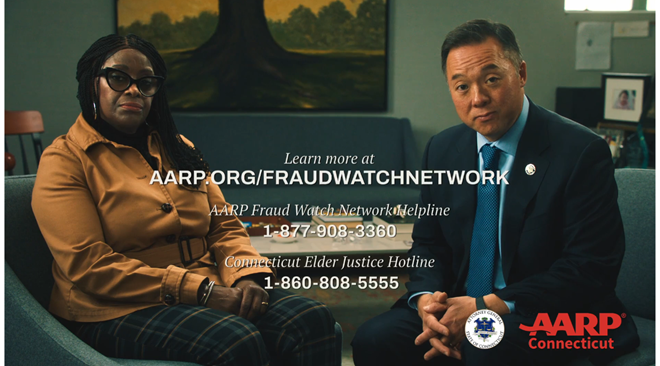
(Hartford, CT) – Attorney General William Tong and AARP Connecticut today announced a Public Service Announcement combatting online exploitation of older adults.
The PSA features Jackie Crenshaw, a 61-year-old breast imaging manager and East Haven resident who lost nearly $1 million in an online romance scam. Crenshaw met “Brandon” on an online dating site. After months of phone calls and texting, gifts and even food deliveries to her home, “Brandon” encouraged Jackie to invest in a crypto opportunity. He shared what appeared to be receipts from the supposed crypto site showing her investment growing rapidly. She borrowed from her retirement account and took a loan against her home to invest more. “Brandon” then sent her a check for $100,000, claiming to be from the proceeds of her investments. Jackie was suspicious and flagged the check for local police and her bank, who told her the account was legitimate. It wasn’t until a year later when an anonymous man called the police to warn that Jackie was being scammed that she and local police realized she had been the victim of a sophisticated international scam. She lost nearly $1 million.
According to the Federal Bureau of Investigation’s Internet Crime Report, Americans lodged 859,532 complaints in 2024 regarding internet crimes, from phishing and credit card fraud to identity theft and romance scams resulting in $16.6 billion in losses.
Adults aged 60 and over comprised 147,127 of those complaints, resulting in $4.86 billion in losses. Of those complaints, 7,626 involved romance scams, resulting in $389 million in losses.
“Jackie Crenshaw did everything right. She was a leader in a profession that was saving lives. She owned her own home. She was a beloved rock of her large extended family. She wanted someone to share in her success, and she thought she had found that love. It was a scam, and now she is bravely sharing her story to prevent others from being harmed,” said Attorney General Tong. “Jackie is just one of thousands of older adults who each year lose their lifesavings to online romance scams. Together with AARP, we are sharing this important information across the airwaves to help stop these scams before they start,” said Attorney General Tong.
The public service announcement was produced in partnership with the Connecticut Broadcasters Association and will air on television and radio over the next 16 weeks.
Attorney General Tong and Connecticut AARP shared the following tips to avoid romance scams.
1. Never send money or gifts to a love interest you haven’t met in person. Scammers will contact you on dating apps and request money, sometimes in the form of cryptocurrency or gift cards.
2. Stay on the dating platform. Soon after they met, Brandon wanted to move their communications off the dating site and asked for her email address and phone number. This is a common tactic: Scammers want to escape the platform so their actions won’t be detected. The other problem? Once a scammer has your name, phone number and email address, they can find your family members, your wages, the property you own. Take time to verify the person's identity before sharing your information.
3. Insist on meeting in person. It’s a huge red flag when someone repeatedly offers excuses for not being able to meet.
4. Beware of “love bombing.” Brandon showered her with gifts — an example of what’s known as love bombing, over-the-top, insincere displays of affection — to manipulate her and gain her trust.
5. Talk to a financial adviser. Don’t rely on your own research or the advice of a crypto-pushing paramour. If your new love interest objects to you seeking outside expertise, consider that a warning sign.
6. Do a reverse image search. Crenshaw and a friend conducted a reverse image search to see where Brandon’s photos had appeared online. In her case, it wasn’t helpful — the searches focused on a basketball player named Brandon Miller — but it’s still useful for detecting an image’s source (Brandon’s pics were ultimately traced to someone else’s social media account).
For assistance and advice on scams, call AARP Fraud Watch Network™ Helpline at 877-908-3360. Toll-free service is available Monday through Friday, 8 a.m. to 8 p.m. ET.
Additionally, assistance is available through the state’s Elder Justice Hotline at 860-808-5555. Individuals may also access information about the hotline, resources, and an online complaint portal here: https://portal.ct.gov/ag/elderhotline. The Office of the Attorney General, in cooperation with the Coalition for Elder Justice in Connecticut (CEJC), launched the Elder Justice Hotline in 2021 to help older adults in Connecticut seek information, assistance, and justice. The Consumer Advocacy Section of the Office of the Attorney General staffs the hotline and refers matters as appropriate to agencies across state government.
###
- Twitter: @AGWilliamTong
- Facebook: CT Attorney General
Media Contact:
Elizabeth Benton
elizabeth.benton@ct.gov
Consumer Inquiries:
860-808-5318
attorney.general@ct.gov
Legal Disclaimer:
EIN Presswire provides this news content "as is" without warranty of any kind. We do not accept any responsibility or liability for the accuracy, content, images, videos, licenses, completeness, legality, or reliability of the information contained in this article. If you have any complaints or copyright issues related to this article, kindly contact the author above.
